

Principal Tsang Cheuk Lung Gary (centre), English teacher Ms Chan (first from left), and Music Panel Head Ms O (first from right) of S.K.H. Yuen Chen Maun Chen Jubilee Primary School shared their school-based practical experience and insights on AI literacy.
Following the Education Bureau's release of the Blueprint for Digital Education in Primary and Secondary Schools, many schools have begun incorporating the ‘use of artificial intelligence to support learning and teaching’ into their school development plans. However, what schools need to promote is not merely having teachers ‘use’ AI tools, but learning how to ‘make good use of’ them to genuinely enhance teaching and learning.
Between ‘use’ and ‘make good use of’ lies precisely AI literacy.
How can this literacy be put into practice in daily classrooms? We visited S.K.H. Yuen Chen Maun Chen Jubilee Primary School to have their English and Music teachers share their practical experiences with us.
English: Returning the Time Saved to Classroom Design and Focusing More on Student Feedback
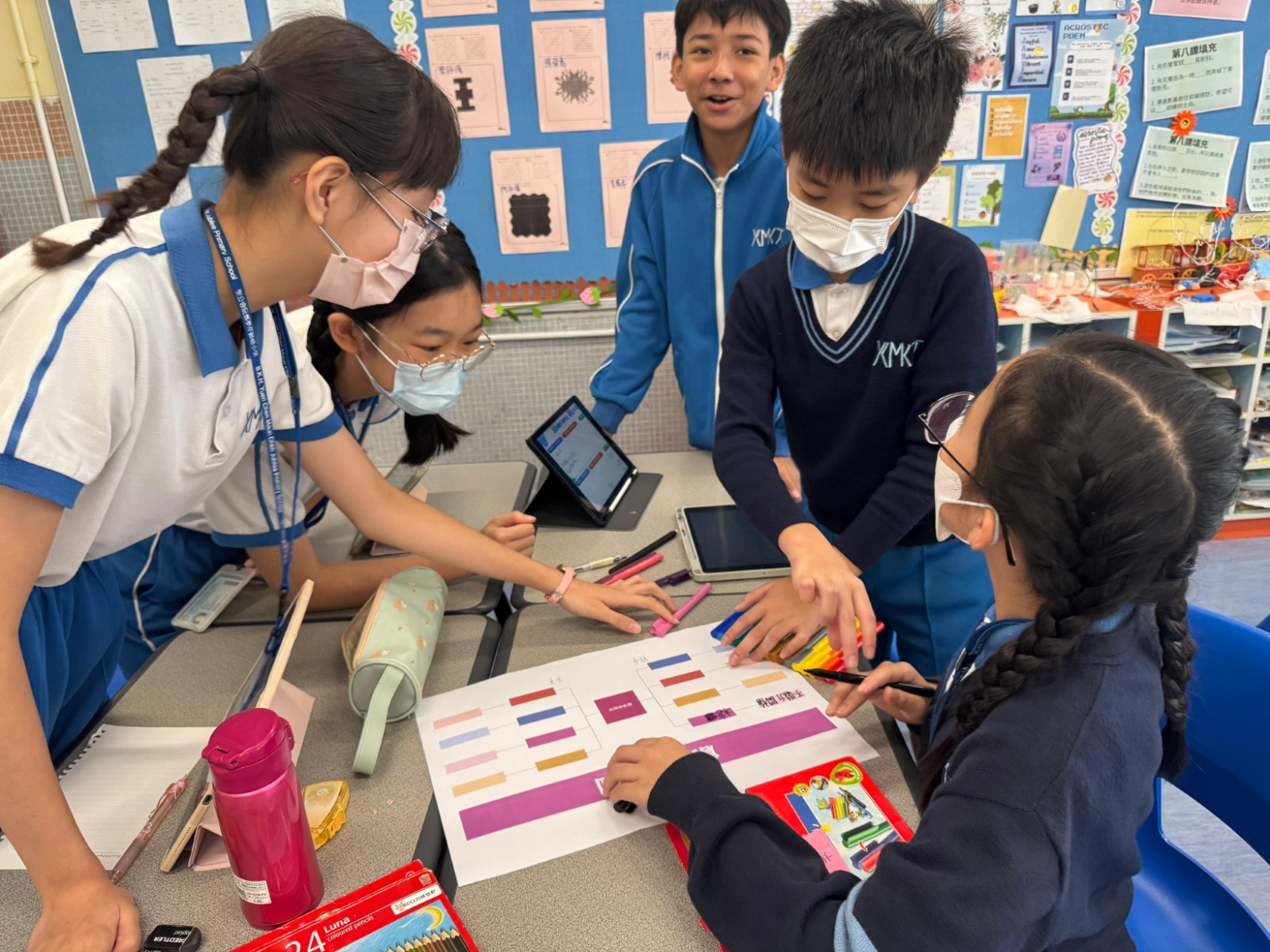
‘Do students really understand the vocabulary and sentence structures they are using, or are they merely using AI to generate expressions that exceed their current level of mastery?’ Ever since AI tools were introduced into English writing classes, English teacher Ms Chan has encountered pieces of writing where the language proficiency did not match students' usual standards. She understood that not every student knows how to judge when and how to use them. Yet, her very first self-reflection was: ‘Is my classroom design and guidance still insufficiently clear, failing to help students understand when to use, how to use, and why to use AI?’
When knowledge and model essays are readily accessible, she realised that ‘AI literacy’ has become more important. ‘It is not a matter of simply handing you or the students a tool to use however you please. The key lies in how teachers design contexts and guidance to teach students, using it purposefully and with discernment.’
Why is she still using AI tools for teaching? She had students use AI tools to design English learning games: ‘The students were really excited, collaborating with one another and revising iteratively. This not only enhanced their use of language, but also trained their creativity and empathy.’ Aside from boosting the classroom atmosphere, the tool also ‘lightened the burden’ for her, saving a considerable amount of administrative and paperwork time.
And she used this saved time to refine her lesson design. Take Primary Four English writing classes as an instance: students must complete a first draft first with their own ability, then upload it to an AI tool she has pre-configured—one that does not directly provide answers, but instead focuses on questions and feedback. They obtain feedback on content, structure, and grammar, revise it themselves, and then submit it to the teacher for review and feedback. What ultimately needs to be handed in is not just an essay, but also the revision log, the complete dialogue with the AI, and a reflection—detailing ‘what was gained from the AI and what was deliberately left unused’.
‘What I assess is not merely that essay, but the entire thinking process in between. Naturally, the feedback becomes more comprehensive.’
Looking back at this transition, she admitted, ‘At first, I was very worried—how exactly should AI be used correctly? But as I tried it out step by step, my confidence grew. Even today, I still need to continually enhance my professionalism and literacy—because we are here to guard the gate for our students.’
Music: AI Generates Sounds, Yet Teaches Students to Retain Emotion
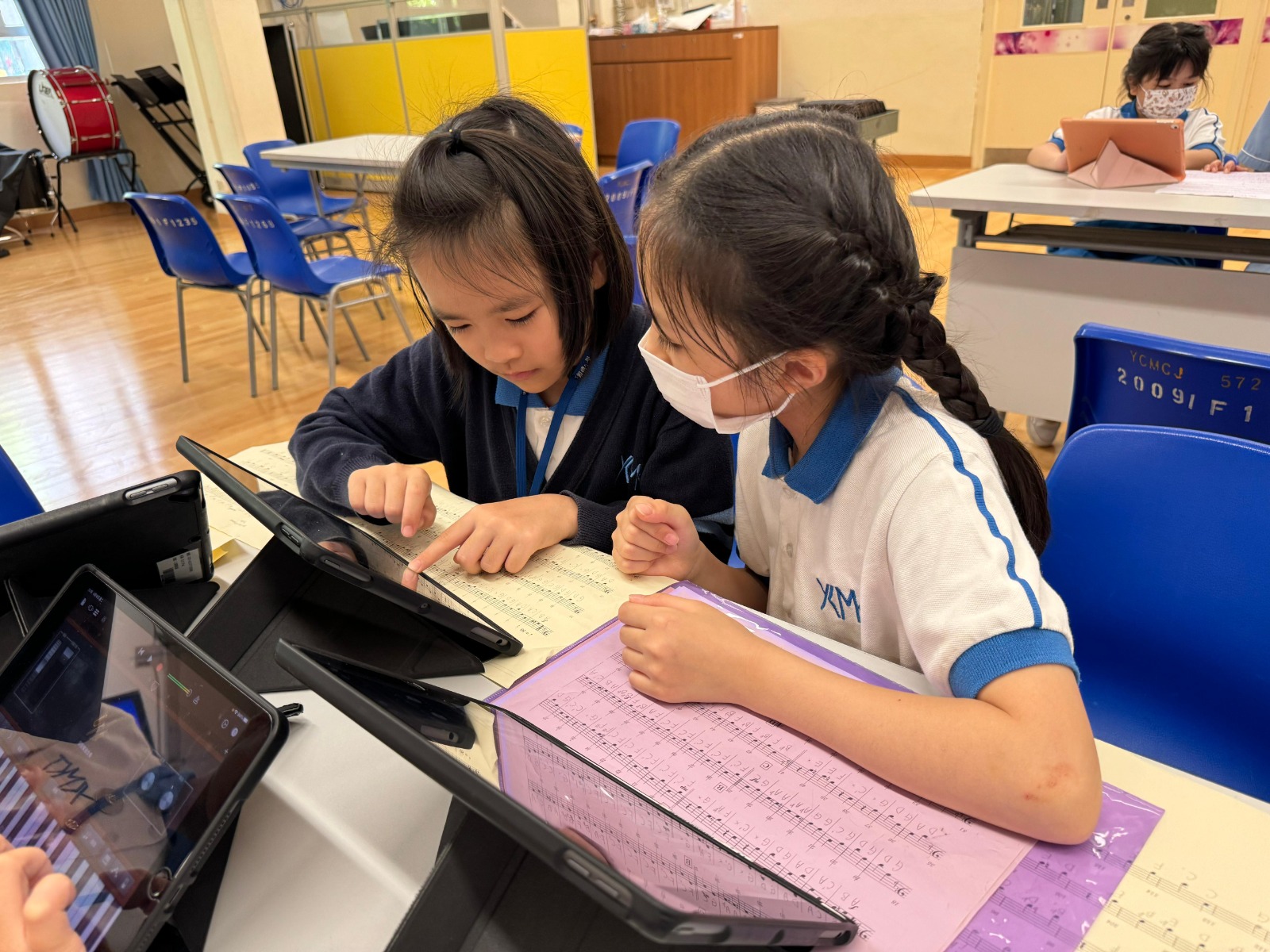
If the challenge in English lies in judgement, then the more abstract subject of Music presents a different kind of difficulty altogether—'because music requires emotion’, as Music teacher Ms Or astutely points out.
Yet in her view, AI has significantly lowered the barrier to creation, making it possible for everyone to compose. In the past, many students struggled even to write a four-bar melody. Nowadays, by simply entering a theme, they can quickly hear a complete song. ‘The students' initial reaction is “wow”—turns out I can do it too.’
However, she is well aware that the value of AI does not lie in finishing the work for students. ‘AI is merely a starting point. After students produce their output, how teachers guide them forward—that process is what matters most.’
Music covers four key domains: fostering creativity and imagination, developing musical skills and processes, cultivating the ability to appraising and appreciating music, and understanding music scenarios. Taking a Primary Six music lesson as an example, she explained that true learning only begins once students finish their pieces with the help of AI. The assignment was a piece of contemporary folk music with a light and breezy style, yet the lyrical background dealt with war and peace. Students identified this cognitive conflict and asked, ‘Why is such a heavy theme paired with a light, breezy style?’ The teacher then prompted students to find clues from the lyrics and guided them to consider how they would reorganize the lyrics and choose the musical style when creating another song, thereby enhancing their ability to appraise and appreciate art.
Throughout the process, students raised many unexpected questions spanning music, general studies, and languages. ‘This precisely shows that AI is a starting point—it sparks students' curiosity. What I look at is not merely that final piece of work, but whether they are able to enhance their questioning skills, comprehension, discernment, and creativity through the lessons I design.’
She believes that music lessons must teach students to safeguard human uniqueness and hold onto their own emotions. ‘Being replaced is not something that only happened because of AI—even without AI, a person could be replaced by another.’ Precisely for this reason, she repeatedly emphasises that AI is merely a tool or a supportive role. While AI is indeed already capable of accomplishing many tasks in information processing, efficiency, and content generation, teachers should accompany students to inspire the core human values of our next generation, such as wisdom, creativity, empathy, and ethics.
On this path amidst a rapidly changing society, teachers are in fact also learners. Over the past year, she has spent a considerable amount of time repeatedly exploring how to integrate AI into music teaching. She has also gained substantial insights from students' in-class feedback, which she uses for further refinement. Therefore, current AI-enabled lessons serve as a companion journey of mutual learning between students and teachers.
Principal: Encouraging Teachers to Let Go of ‘Knowledge Authority’ and Walk Alongside Students
‘Following the emergence of generative AI, merely identifying what is true or false is no longer enough. With a device in hand today, students can look up anything. Knowledge is no longer the challenge – the difficulty lies in what they choose to do once they have discerned it clearly.’ In the Principal's view, ensuring students learn AI literacy brooks no delay.
For students to learn, teachers must learn first. ‘Past digital transformations may have only involved some teachers, but in the era of artificial intelligence, no teacher can stand aloof.’ His approach is to have department and subject heads learn and try first, who then lead their colleagues forward together; teachers must also learn to set aside the identity of ‘knowledge authorities’, transforming from speakers into pathfinders to engage in learning by doing.
He is not worried about teachers being replaced. ‘Because no matter how fast technology advances, what ultimately needs to be safeguarded is humanity. When knowledge is readily accessible, we must instead spend time teaching thinking and character, passing correct values directly into the hands of students.’
Related article: Expert Perspective: How to Learn and Teach AI Literacy?