

Learning & Teaching Expo 2026 has concluded successfully. This year’s theme, 'Reimagining Education: Human-Centric, Future-Ready', perfectly outlines the direction and focus of education in the AI era: human-centred, with technology as an auxiliary tool. On the Learning & Teaching Expo stage, numerous educators from overseas, Chinese Mainland, and local communities shared with us their forward-looking perspectives, as well as classroom practices on issues such as the application of AI in teaching, professional development for teachers, and changes in student learning modes. Let us review some of the highlights together.

How many countries worldwide have implemented national AI policies? The answer is 75, and this has all taken place within only the last three to five years.
During the Principals’ Conference at the Learning & Teaching Expo 2026, Dr Maria Spies, Co-Founder of Holon IQ and Chief Innovation Officer of Quacquarelli Symonds, delivered a global outlook on AI in education. She opened with a definitive premise, ‘AI is another phase in this gradual digitization that the world has been going through for about 30 or more years. We have trends over a period of time – mobile learning, personalized learning and social learning. It's changing the way kids – how they get information, how they get ideas, how they process things. 37% of worldwide of consumers don't start just in a normal browser, but they start inside an AI tool, which is probably more of a higher percentage with younger people being native to artificial intelligence. It's changing behaviours.’
According to the latest global EdTech data, she pointed out, ‘Teacher productivity, personalized learning and tutoring and learning support – practical solutions for teachers, for schools, for learners and their parents.’ Dr Maria Spies and her team analysed numerous global successful AI projects in educational context and concluded seven factors that contribute most: not investment, not hardware, but ‘the willingness to explore an experiment’. ‘If that is not present, the project often fails.’
Dr Maria Spies also raised that ‘stop treating the frictionless AI (everything is completely effortless and the AI automatically handles all the details) as the actual goal’. When students become highly dependent on AI without any cognitive engagement, learning simply degenerates into 'copying answers.' Using the example of a math teacher requiring students to 'show your workings,' she explained that true learning lies in the thinking process, not just the answer. As a result, 'productive friction' is emerging as a new focus in global research on AI in education.
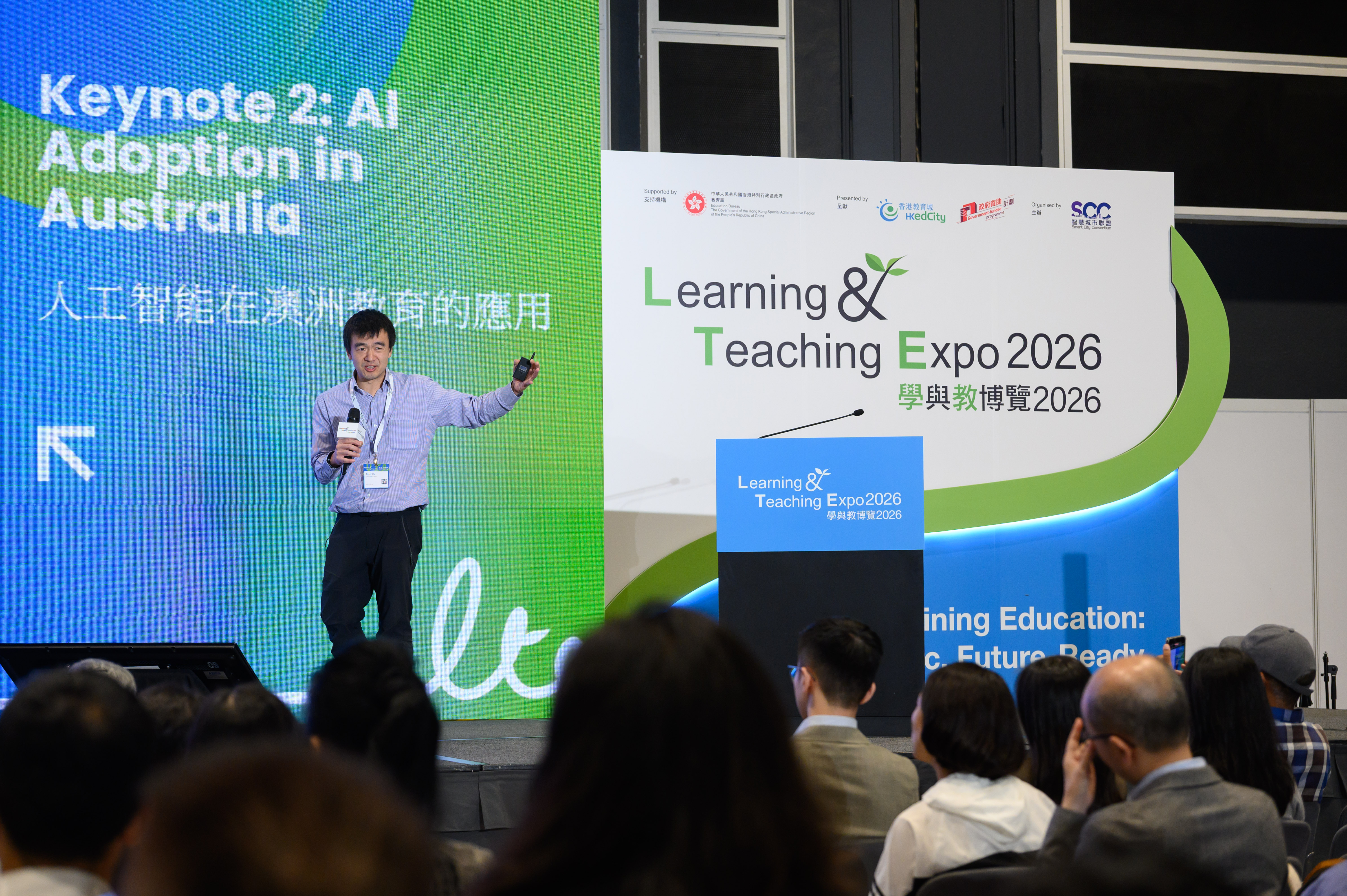
Professor Danny Liu, an expert of Educational Technologies from The University of Sydney shared case studies from Australian classrooms, offering another perspective on the immense possibilities already existing within AI education.
Rather than purchasing ready-made AI tools for educators, their approach enables teachers to personally design tools suited to their students' specific needs. Teachers only need to use natural language to describe the interactive learning tool they require, and the platform assists in generating it. Upon completion, the tool can be directly integrated into the school’s learning management system for students to access at any time.
More importantly, educators can review students' dialogue records with the AI in real time. Professor Liu shared a compelling observation: ‘You'd be surprised how much more your students will say on AI than they say to you in person.' These conversation logs allow teachers to gain deep insights into what students genuinely comprehend and at which precise stage they encounter difficulties—information that is difficult to obtain through conventional classroom observation. The core philosophy of this practice is to return the autonomy of AI to the teachers.
In another example, they invited a student who was usually less engaged in class to try using the platform to design a learning game for their peers. Unleashing their creativity, the student designed a challenge-based game complete with a villain: if players answered a question correctly, the villain lost health points; if they got it wrong, they lost points themselves. The rules were simple and straightforward, yet it had students across the whole school competing and choosing to stay behind during lunchtime just to play.
The takeaway from this story goes far beyond 'gamified learning.' When students shift from being 'users of AI tools' to 'designers of AI tools,' their learning initiative and engagement are completely transformed.
Human-Centric, technology as an auxiliary tool
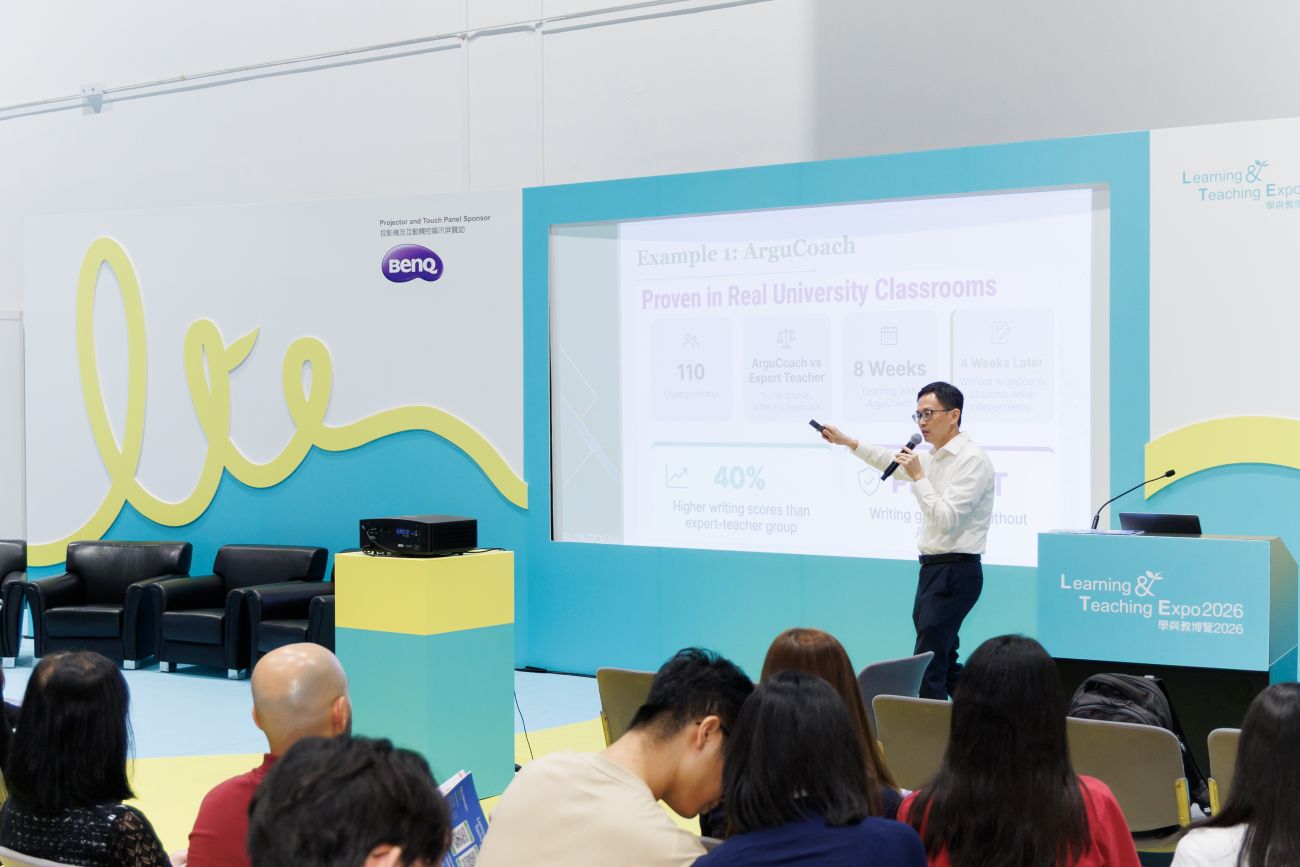
While understanding global trends is important, classroom practice is equally vital. Professor Timothy Hew from the University of Hong Kong, whose research expertise lies in leveraging technology to support education and learning, brought the focus back to the classroom during the 'Future Education Theatre' in the sharing session ‘Teaching with AI: Supporting, Not Replacing, Student Learning’. Through concrete research case studies, he provided teachers with immediately actionable pedagogical directions—namely, teaching with AI: supporting, not replacing student learning.
- Guided AI
Professor Hew’s research team designed a guided AI tool for secondary school English argumentative writing. When a student asked the AI, ‘should university education be free? I'm arguing yes. Give me a strong opening statement', the AI didn't just give them the answer. Instead, it prompted them back, ‘Tell me, what is one reason you think that university should be free? I will help you build an argument.'
The key to this design is requiring students to express their own thoughts first before getting any help from the AI.
Result: After using this tool for eight weeks, the 110 participating students showed significant improvements in their writing skills. What's more, their progress continued even four weeks later – proving that the students had truly internalised the learning rather than just relying on AI outputs.
- Planning, Monitoring, and Reflection
In this session, it also sparks discussion on the application of the same concept to primary schools, designing three learning stages to help students build self-regulated learning habits.
Before class: Students set goals and write down their problem-solving plans—'What do I need to master today?'
During class: When facing difficulties, students first try to describe their thinking in words before asking the AI for hints.
After class: Students evaluate their learning process— reflect on their problem-solving process and review the interaction with AI.
The experiment showed that 110 students who received both AI guidance and teacher intervention achieved the most outstanding learning outcomes, and the quality of their interactions with the AI was significantly higher.
‘In order to make sure students learn, you need to force them to have cognitive struggle,' he said. This is a point that every educator should seriously reflect upon.

These conversations are just a small glimpse into the 300 spectacular sessions held—covering everything from digital literacy and how to get kids to put down their phones willingly, to how educators can embrace 'reverse learning' from students when it comes to AI. Every single session offered invaluable insights to reflect upon.
We look forward to seeing you at next year's Learning & Teaching Expo 2027.
24–26 June 2027
Hong Kong Convention and Exhibition Centre