

Two lessons a week, 35 minutes per session—this is all the time primary school students can have for PE lessons in Hong Kong.
Exercise does not only improve physical fitness, but it also leads to better concentration and academic performance for students. The importance of Physical Education is gaining increasing attention. In view of this, the Education Bureau will be including PE in the Internal Assessments for Secondary School Places Allocation (Pre-secondary Internal Assessment) starting from the 2026/27 school year.
For schools, it may be a challenge to balance teaching, assessment and following-up students’ development within the limited time. The initiative launched by Po Leung Kuk Chee Jing Yin Primary School two years ago has brought a new prospect: turning AI into a powerful assistant for teachers.
On your mark, set, go!
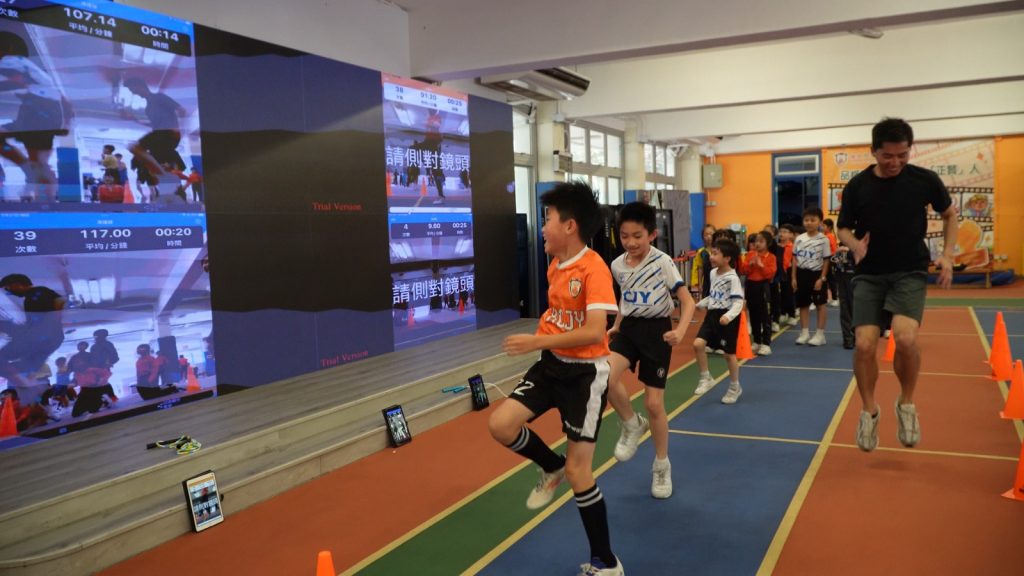
It may be difficult for teachers to “have eyes in the back of their head” during PE lessons when there are 20 to 30 pupils in one class. It could already be a challenging task to count the running laps of every single pupil accurately, let alone providing guidance on their movements and postures individually. Even if other pupils are invited to assist with counting, the task is time-consuming and the results may be inaccurate due to human error.
Physical Education teacher Mr Hau Hin Yeung from Po Leung Kuk Chee Jing Yin Primary School shared with us about the AI tool the school is currently using – Robocoach. Developed by the Hong Kong University Sport AI Lab, Robocoach tracks the number of laps completed by each student in real-time through a smartphone camera, while monitoring and analysing their posture with AI at the same time. Mr. Hau can easily monitor the whole class at a glance by standing at the centre of the playground, allowing him to focus on observing students’ movement and providing immediate guidance. This level of feedback can only be achieved via one-on-one tuition. AI not only improves learning and teaching efficiency, but also lead to a more convenient and objective way of assessment that supports personalised teaching.
The invisible coach after class
Even though there is limited time for PE lessons, habitual physical activities definitely should not be limited to 70 minutes a week. AI tools allow students to extend these habits after school and in their spare time, while correcting and recording physical fitness, posture and flexibility.
‘Having fun’ is the biggest incentive for children to incorporate exercise in their daily life, as Mr Hau suggested, ‘Students think it’s fun and love to compete with friends for high scores.’ Robocoach features a leaderboard, where students can enjoy a variety of fitness games and compete with fellow classmates and friends for fun. The application can also link to ‘MVPA60 Award Scheme’ of the Education Bureau, awarding students with certificates when they have accumulated 60 minutes of physical activities each day in a week. Integrated with the school’s ‘CJY Reward Scheme’, students receive reward stickers if MVPA60 target is achieved. Students can exchange these stickers for school-based prizes, such as capsule toys or chances to experience VR activities, making it even more appealing for students. A number of parent meetings are held to explain and demonstrate the functions of AI tool – some parents even start joining their children to exercise after they have familiarised themselves with how to use it, strengthening family bonds.
Breaking through limitations
For the school, AI does not just help with breaking through ‘human resource’ constraints, it also enables faster data collection and management. Data is more objective and administrative workload is reduced. ‘Spatial’ constraints can be broken by AI as well. By using Micro:bit, a digital tool for softball lessons, distance can be calculated based on the impact force when students throw the softball onto a Micro:bit device. Spatial constraints are no longer an issue. With the help of applications like Robocoach, a comprehensive data system can be established to assist the school in managing the requirements of Physical Education for internal assessments more efficiently. Completed this year, the "Eureka Space" VR classroom further provides virtual reality interaction, giving students increased opportunities to experience various sports.
Implementing these tools requires significant resources. The funding from ‘AI for Empowering Learning and Teaching Funding Programme’ of the Education Bureau is planned to be used by the school on physical education, as well as other subjects and areas.
AI as the ‘starting block’
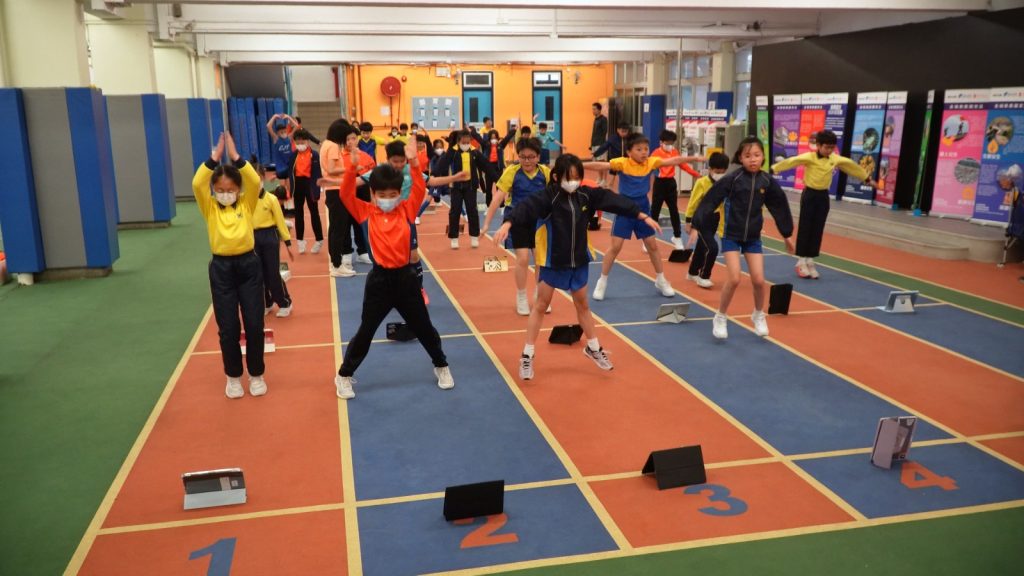
Nonetheless, sometimes the public can’t help but wonder: will PE lessons be reduced to ‘drills’ in the name of internal assessments?
Mr Hau has given a clear reply, ‘The health and growth of students are what matter the most. Our school has always been proposing different ideas to motivate and engage students to do more exercises by providing them platforms and opportunities.’ He believes AI is auxiliary, which completes assessments and administrative work more efficiently, allowing teachers to focus on teaching and for students to enjoy sports, rather than simply focusing on examination techniques.