

Research Background
This study aims to explore how image-based generative AI can support English writing. In the wave of research and teaching development using Generative AI technologies, much of the focus has been placed on secondary school students and higher education. Moreover, most GenAI research has been text‑based, either using chatbots or relying on text‑driven feedback. Amidst this, one group of English learners has been largely overlooked—primary school students, who particularly need teachers to act as facilitators of learning.
Research
The study involved 33 boys, aged eight to nine, who completed an assignment on completing posters on the theme of ‘My Homemade Toy Car’ through a 10-day classroom action research project, spanning seven 30-minute lessons. Students first read examples and drew mind maps, then learned to write prompts, used Padlet's AI image generation feature to visualize their designs. Finally, they wrote an English description of about 50 words based on the images, followed by peer feedback and reflection.
The implication of this study is not to have AI replace student writing, but rather to enable students to express their ideas more proactively through generation, observation, peer discussion, and revision with teachers acting as the facilitators of learning.
Details of Classroom Teaching Design Process
| Phase | Lesson | Procedure |
| Pre-design | Brainstorming with mind maps | Mind map worksheets |
| Prompt engineering instruction and technical instruction on how to generate images with GenAI | Teaching slides, Padlet AI Images | |
| Design ↔ sharing | Generating GenAI images | Padlet AI Images, Padlet sharing |
| Peer review on generated images | Padlet sharing | |
| Design (Writing) | Writing with reference to the generated images | Writing task |
| Reflection ↔ sharing | Peer review and self-reflection of written work and generated images as a video presentation | Video presentation on Padlet |
Getting Started: Conceptualisation Through Generative Images
As a former primary school teacher in Hong Kong, Dr Alex Lam Lap Kwan from the Department of Curriculum and Instruction at the Education University of Hong Kong sought to support primary school students. When these students try to write about a certain topic, they may not lack ideas, but rather struggle with how to turn the images in their minds into words. If imagination can be made ‘visible’ first, would they be more willing to start writing? However, when first using AI to generate images, the primary challenge is ‘how to enter accurate and appropriate prompts’ so that AI can present what they envision in their mind.
Since learning took place in groups, even if some students were unable to express themselves fully in English, they could still point to the pictures and explain their meaning to another student. Generating images lowered the threshold for participating in discussion, giving these primary school students the opportunity to complement each other's vocabulary, negotiate meaning, and solve problems. For example, when a student did not know the word ‘transparent’, they could point to the transparent part in the picture and say ‘like this’. In addition, the AI-generated images were interesting and vivid. The study also observed that even students who were usually not very active in writing classes showed sustained interest. ‘I kept writing because I wanted to see what the AI would draw next’ – the students' own voices demonstrate that students of different language proficiency can all find enjoyment in the process.
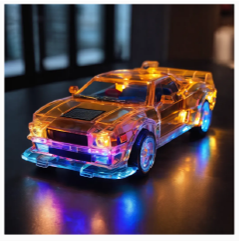
During the Journey: Continuous Revision Brings Continuous Improvement
To externalise mental images, the first prompt may not necessarily generate the most accurate picture; repeated revisions are needed for the desired result, making the students' language proficiency particularly important. ‘From generating an ordinary race car using the prompt 'fast car', then modifying it to “car faster than rockets” which generated a spaceship, and finally entering 'a fast toy car that looks like a rocket' to get what exactly the student has imagined. This cycle of input, comparison, revision, and selection helps them externalize mental images while developing more precise linguistic descriptions.’ The study found that learning from ‘inarticulate expression’ through continuous revision is precisely the process of students' language development.
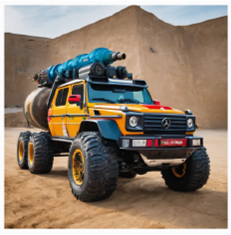
Although AI can guide students in independent learning, it cannot completely resolve the problem of ‘inarticulate expression’. The role of teachers here is to help these young English learners transform these misinterpretations by AI into learning opportunities, guiding students to reflect on which parts of the prompts generated the most matching images and which parts were misunderstood by AI. By emphasizing the use of descriptive language such as adjectives, similes, and other modifying phrases to clarify and enrich the prompt, attempts can be translated into conscious learning.
Turning Point: To Inspire, or to Limit? That’s AI’s Surprise.
One student in the study initially only had fragmented ideas such as ‘four wheels’, ‘rocket body’, and ‘can fly?’. After modifying the prompts and having repeated discussions with classmates, he eventually generated an image featuring propellers and wheels, which provided him with a starting point to describe a flying toy car, subsequently allowing him to add details such as a battery and retractable wheels. However, another student wanted to design a car made of rubber, but the AI-generated images related to rubber bands. After multiple attempts, he felt frustrated and even changed his original intention to accommodate the picture. This student eventually gave up, deeming the AI ‘broken’ and ‘not smart enough’. This case reveals a key issue: the effective use of generative AI images relies not only on language proficiency, but also on the alignment between the learner's intention, language expression, and the AI's interpretation ability.
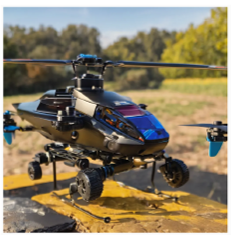
These two cases reflect that AI output should not become the standard answer. When a generated picture does not match the expectations, it may involve the way it is described, or it could be due to the model's limitations. AI literacy is not just about knowing how to input commands, but also includes judging the outputs, understanding limitations, and deciding when to adopt or discard them. However, teachers can turn situations where text and image do not match into materials of discussion, guiding students to compare their original intention with the result, rather than blindly pursuing ‘successful generation’. What is truly worth pursuing is not whether AI can draw more prettily, but whether students can express their own ideas more clearly and how they can articulate those ideas better.
The study provides front-line English teachers with concrete recommendations:
- Conceive first, generate second: Use mind maps or sketches to preserve original ideas, avoiding being completely led by AI in the creative process.
- Provide language support: Pre-teach vocabulary related to colours, shapes, materials, and actions, and demonstrate the use of adjectives and similes.
- Involve peers in judgment: Compare prompts and pictures, and discuss which details match and which need adjustment.
- Emphasise revision and reflection: Keep records of prompts and ask students to explain their choices, rather than merely assessing whether the pictures are aesthetically pleasing.
Overall, through careful planning and appropriate integration into classroom teaching, thoughtfully integrated image-based GenAI tools can serve as valuable pedagogical resources, promoting purposeful and engaging language learning in the digital age, thereby emphasizing the relevance of image-GenAI to support meaningful multimodal language learning experiences for young English learners.
Soucre:Lam, A.L.K. (2026), Supporting Young Foreign Language Learners With Image Generative AI in Digital Multimodal Composing: Benefits and Challenges. TESOL Quarterly. https://doi.org/10.1002/tesq.70216