
The same classroom and the same lesson.
Some students think more quickly, with the answer already in mind before the question has even been fully asked, while others need a little more time to read and write, working quietly to keep up. Some run around the playground at recess to burn off their energy, while others need to pick up a paintbrush to organise their thoughts. Still others harbour anxieties within, unsure how to put them into words.
These are all different learning needs, and each reflects a child’s unique qualities and pace. How can one teacher see every child and help each of them play to their strengths?
AI may offer innovative possibilities for empowering students and teachers. Sung Tak Wong Kin Sheung Memorial School shared with us how robots help students become more confident and better interact with people, while Fung Kai No.1 Primary School shared how technology can lighten teachers’ workload, allowing them to devote more time to their students.
When innovative technology enters the classroom, every child has a chance to shine on stage, and every teacher has the space to care for them, empowering both to reach their full potential.
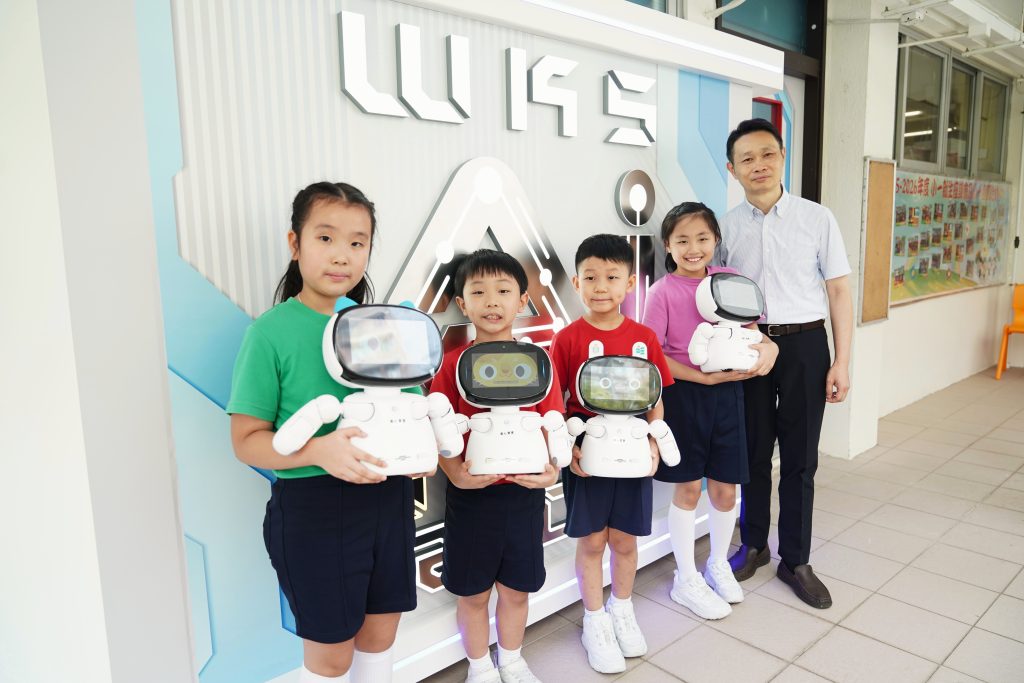
Principal Raymond Wong Wing Shing (first from right) and Primary Three students from Sung Tak Wong Kin Sheung Memorial School.
Four Primary Three students immediately broke into bright smiles at the sight of their ‘special guest’.
Some watched it sing and dance, some experimented with programming, while others asked it to tell a joke. This ‘special guest’ is an AI-powered robot called ‘Loving Baby’, which makes occasional appearances during recess to interact with the students.
Supporting Teachers in Providing Emotional Support
In recent years, Sung Tak Wong Kin Sheung Memorial School has participated in a research project conducted by the Institute of Special Needs and Inclusive Education at The Education University of Hong Kong (EdUHK), during which the school was provided with the ‘Loving Baby’ emotional support robot for free.
Cute and animal-like, Loving Baby can dance, chat and react to hand gestures with lifelike expressions, such as looking in the direction of a pointing finger, sneezing when its nose is tapped and showing a displeased expression when its face is touched.
Principal Wong recalled a student who had always been reluctant to talk to others but became remarkably talkative with the robot, as if meeting a good friend.
Students tend to open up more readily when talking to Loving Baby, making it easier for them to express their emotions freely in a relaxed setting. ‘I’m feeling a little unhappy today...’ If Loving Baby hears a student opening up about their feelings, it offers words of comfort, ‘I understand that you’re feeling a little unhappy today. Take a break and give yourself some time to relax!’ Throughout the process, a counselling teacher or social worker stays alongside the student, ready to offer guidance or counselling whenever negative thoughts or emotions are observed.
The robot also shares Positive Stories to help students understand and accept different emotions. For example, ‘The Tear Collection Jar’ tells the story of a rabbit that cries for different reasons, such as anger and sadness. When its tears are placed in a collection jar, they turn into gemstones of different colours. This helps children understand that tears can provide an outlet for different emotions, and that emotions are not something to fear. Instead, they allow different feelings to be expressed.
Principal Wong believes that the robot serves as a bridge between teachers and students, ‘There was once a student who opened up while listening to a Positive Story, sharing the negative emotions arising from a past experience and how the story resonated with him. The teacher then took the opportunity to explore with the student the effective ways of managing emotions, thereby promoting mental well-being.’ Students’ sharing is kept completely safe and confidential, making them more willing to express their thoughts.
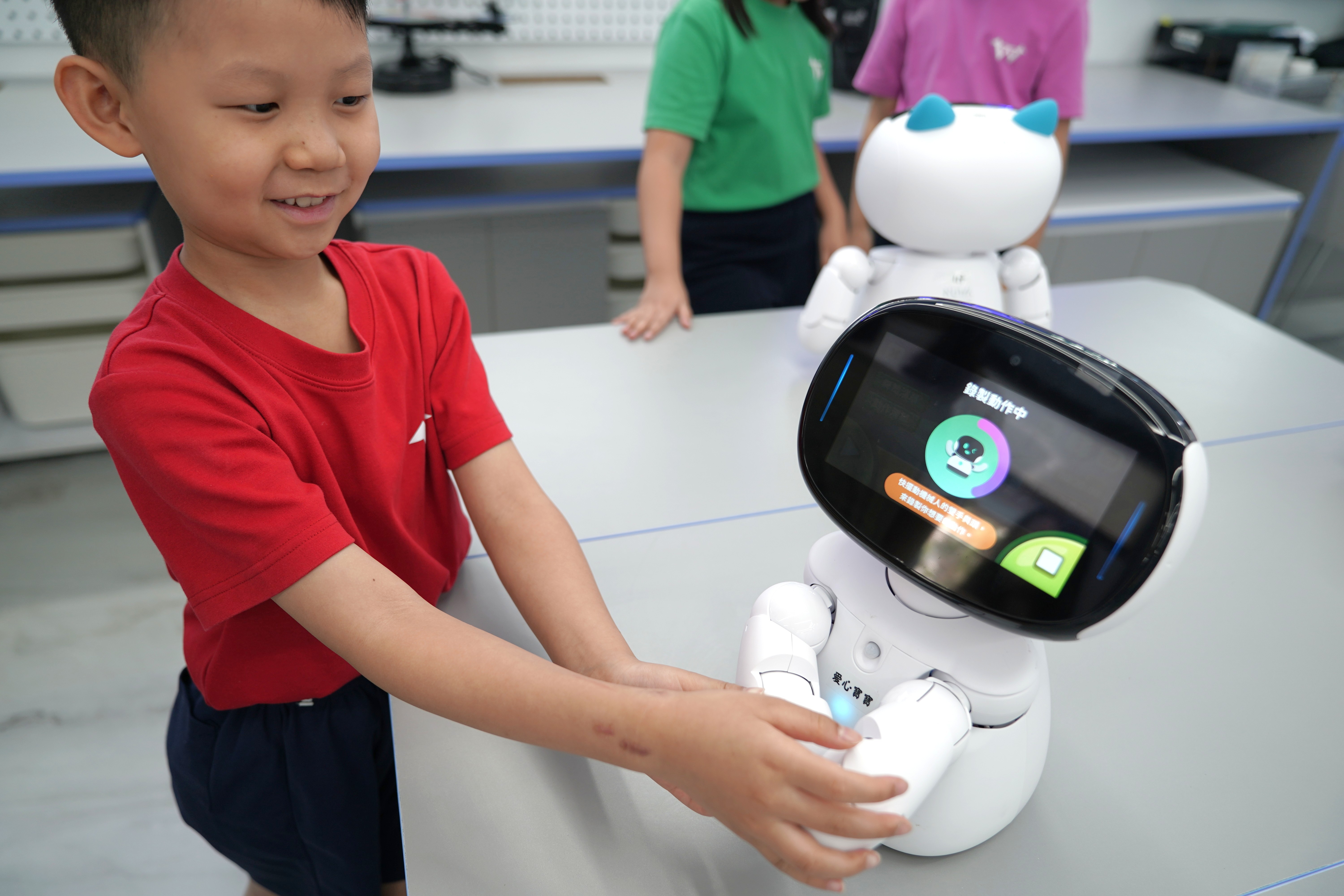
The operation of the robot is user-friendly. Simply moving its arms allows new dance moves to be recorded, making it easy to handle even for primary school students.
The robot also helps enhance social skills. ‘Through Loving Baby, I interact more with my classmates. I’m not as shy as I used to be,” said Primary Three student Siu. Another student Lau also said, ‘Sometimes when we play games, we don’t achieve the goal and have to accept a small penalty, but those penalties are actually fun little games.’
In addition, sharing their feelings helps boost students’ confidence. The robot’s chat function encourages students to express themselves and fosters positive thinking with encouraging responses. Through interactive question-and-answer games, it also helps students expand their vocabulary and build confidence in learning.
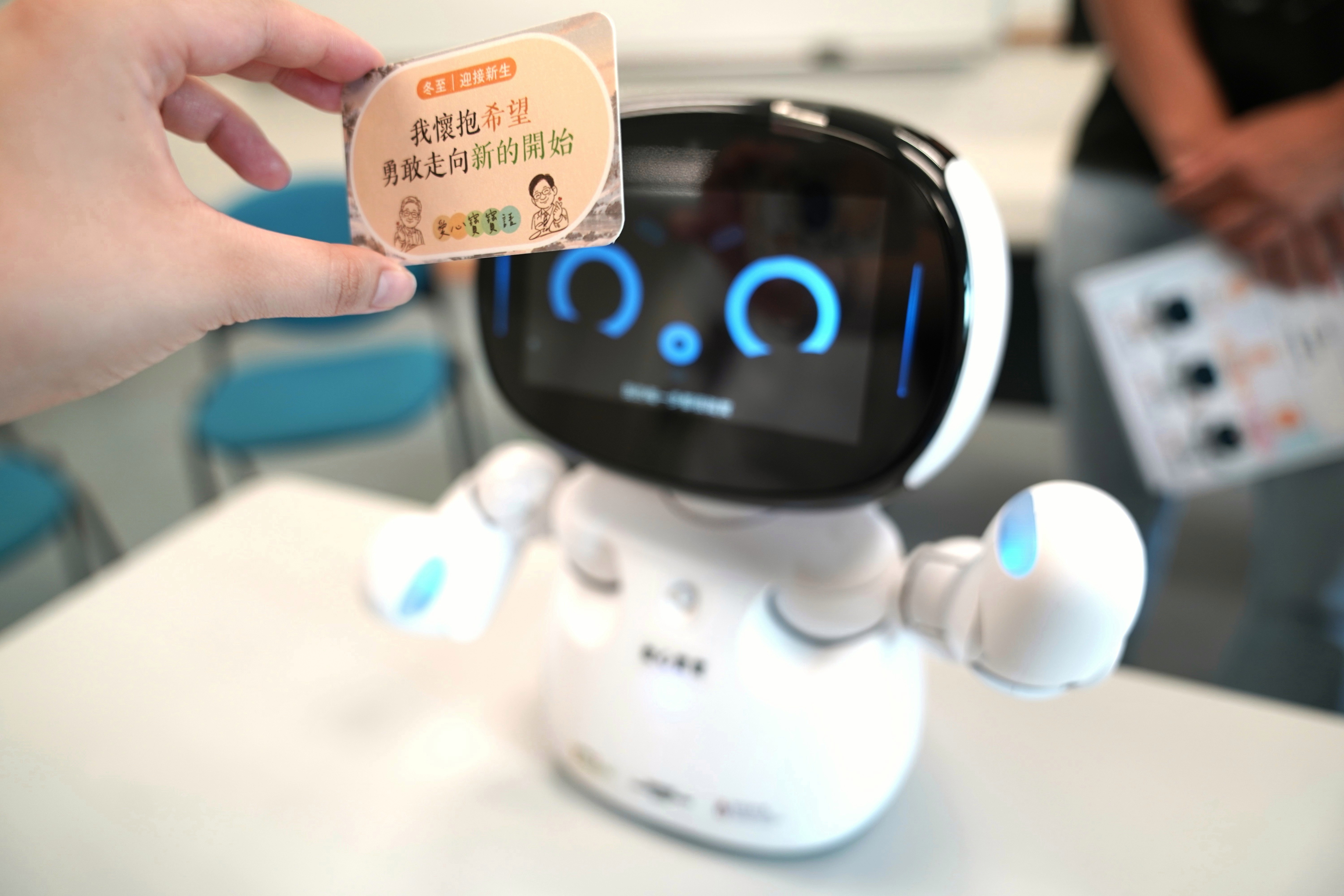
By scanning ‘Loving Baby’s Whispers’ cards that feature positive messages, the robot will read the sentences aloud, allowing students to read along and improve their listening and reading skills.
Robots Help Build Trust More Quickly
Principal Wong also noted that building relationships between teachers and students often takes time. ‘Students usually see teachers as their elders, which creates a certain sense of distance. It is not easy for them to open up about what is on their minds.’ The robot helps students lower their guard, while allowing teachers to learn more about the topics students are interested in. This makes it easier to start conversations with them in subsequent occasions and at the same time, gain a better understanding of their needs.
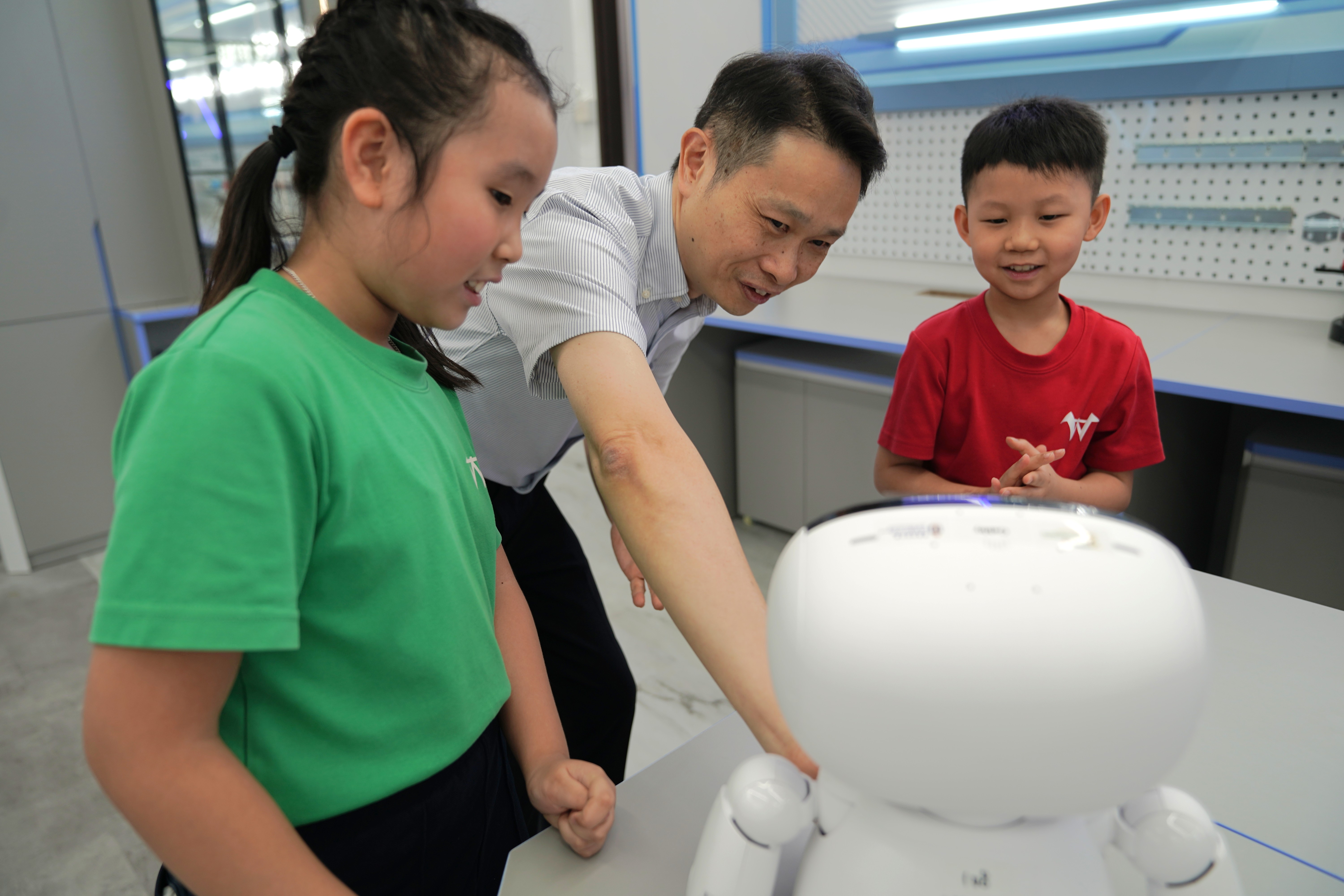
With the presence of the robot, Principal Wong mingled with students more naturally.
Promoting Inclusion through Group Learning
The EdUHK Team also runs regular STEAM workshops for the school’s Primary Three students. On the day of our visit, they brought along small robotic cars and used interactive activities to teach students programming. To cater for diverse learning needs, teachers grouped students with different strengths together. Each group had to work together to plan a route for their robotic car and then turn it into a series of commands, ‘Two steps forward... turn left, then three steps forward, then turn right and move forward two steps...’ The robotic car set off, but took a wrong turn. ‘Hmm... something’s wrong with the route. After turning left, it should move forward two steps before turning right...’ We noticed that the group members did not blame one another. Instead, they continued discussing and trying again calmly. They readily expressed their ideas, asked questions, made suggestions and reflected on their mistakes, demonstrating a positive mindset and a spirit of collaborative problem-solving throughout the process.
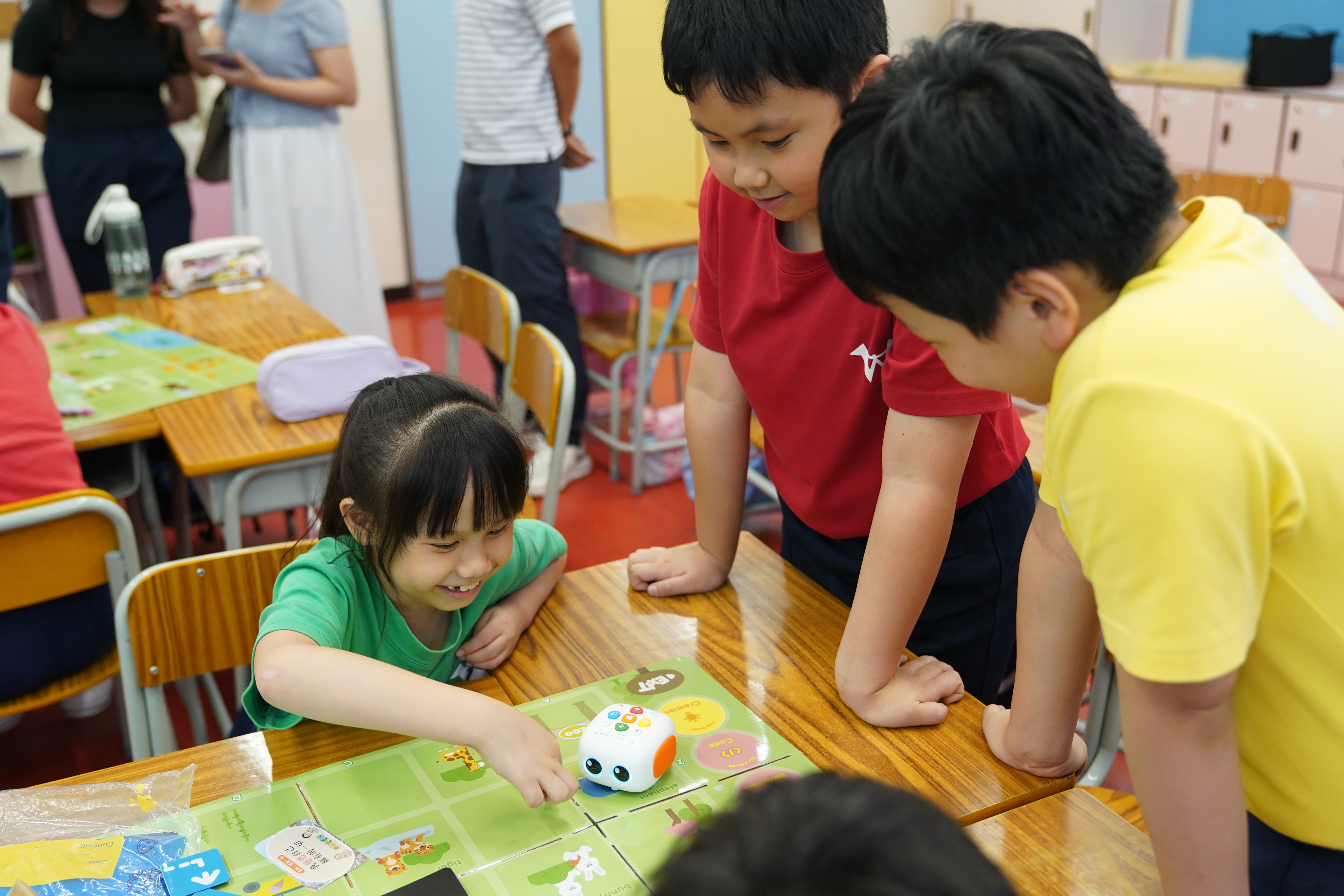
The group members worked together to plan a route for the small robotic car.
Making Innovative Teaching More Widely Accessible
Principal Wong hopes that innovative teaching tools can become more widely accessible so that all students can benefit from them, without limited resources restricting students’ access to such tools and hindering the development of their potential. He also hopes that these tools can provide teachers with practical and effective support in designing lessons around students’ different needs.
Principal Wong acknowledged that even though the teaching team shares the same goals and beliefs, with students’ well-being as their overriding priority, teachers may adopt innovative technologies in their teaching at different paces. Schools need to be understanding and provide appropriate support by regularly arranging on-site training for teachers, as well as opportunities for them to observe their peers’ classroom practices and learn from one another.
To learn more about insights and solutions for supporting SEN with AI, join the following event:
AI in Education Forum
Theme: Innovation for Every Learner
Date: 26 - 27 November 2026 (Thursday-Friday)
Venue: West Kowloon Study Centre (Museum Drive and Austin Road sites), The Education University of Hong Kong
Time: 1 p.m. to 5 p.m.
Organisers: the Education Bureau, Hong Kong Education City and the Education University of Hong Kong
Focus: AI, robotics, and supporting students with special educational needs
Three core parts: Keynote Addresses and Panel Discussions, Hands-On Practice and Training Sessions, EdTech Solution Showcases and Live Demonstrations
Registration and details: https://web.edcity.hk/en/aied/home/
Learning and Teaching Resources:
- Explore innovative education tools: EdMarket
- AI Teacher Professional Training: ‘PD Thursday’ Teacher Continuing Professional Development (CPD) series
Related Article: Expert Insight: Supporting Inclusive Education with Human-Centred Technology
Related Article: Technology Lightens Teachers’ Workload